What matters most when choosing gluten-free pizza: the crust, the ingredients, or how the meal fits your plans? If you’re searching for gluten free pizza Washington DC, it’s natural to consider dietary needs, kitchen handling, and what sounds good for dinner.
Manny & Olga’s Pizza is a family-owned pizza business founded in 1993, with gluten-free pizza on the menu and delivery and carryout options. The menu also includes a broad range of pizzas, subs, Greek specialties, and Italian dishes.
This guide explains what to consider when choosing gluten-free pizza, how to think about cross-contact, and how to plan a delivery or carryout order. Whether you’re ordering for yourself or a group, a few practical checks can help you find an option that fits the meal.
Key Takeaways
- “Gluten-free” identifies a menu option, but doesn’t necessarily mean the kitchen is dedicated gluten-free.
- If celiac disease is a concern, shared tools, surfaces, or ovens may be relevant to your decision.
- Compare gluten free pizza Washington DC options by dietary fit, menu information, ordering format, and convenience.
- Use a short checklist to clarify your needs and choose between delivery and carryout.
- Manny & Olga’s Pizza serves gluten-free pizza, with delivery and carryout options.
Gluten-Free Pizza in Washington, DC: What the Option Means
Pizza night should be straightforward: choose a pie, pick it up or have it delivered, and enjoy dinner. If you’re looking for gluten free pizza Washington DC, a menu label is a useful starting point, but it doesn’t explain every ingredient or how the pizza is handled in the kitchen.
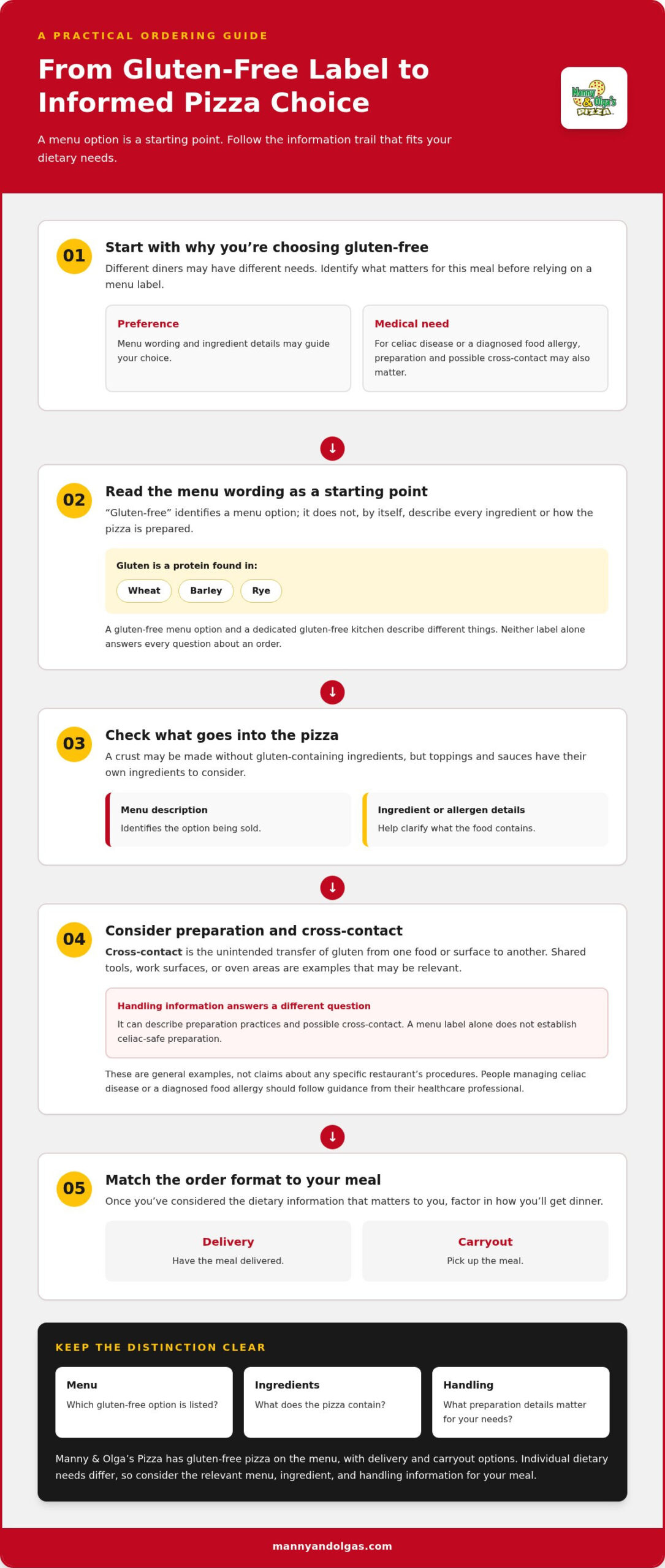
Gluten-free pizza is made with a crust and ingredients intended to exclude gluten, a protein found in wheat, barley, and rye. A gluten-free menu option describes a food choice; a dedicated gluten-free kitchen describes a separate preparation environment. The terms aren’t interchangeable, and neither one alone answers every question about a particular order.
What does gluten-free mean on a pizza menu?
A menu may use “gluten-free” to identify a crust option, but that wording doesn’t describe every topping, sauce, or preparation step. Toppings have their own ingredients to consider, and shared tools, work surfaces, or ovens can create opportunities for cross-contact. A dedicated gluten-free kitchen, by contrast, describes the preparation setting. Treat the menu label as a helpful starting point, not a complete account of the meal.
This distinction helps you make a choice without assuming one label answers every dietary question. Someone avoiding gluten by preference may focus on listed ingredients, while a diner with a medical need may also need to consider kitchen handling. First identify why you’re choosing the option, then weigh the information that matters for that need.
Who might look for gluten-free pizza in DC?
People choose gluten-free pizza for different reasons. Some have celiac disease, an autoimmune condition associated with a need to avoid gluten; others have a wheat allergy or choose to limit gluten as a personal preference. A brief overview of celiac disease explains why avoiding gluten can be a medical need for some diners. Individual needs differ, so don’t assume everyone choosing this option has the same requirements.
It can also be a practical choice for families, friends, or coworkers ordering together. One person may have a medical dietary need, another may avoid certain ingredients, and others may simply want a different pizza option. A gluten-free menu choice can give a group another option, but it doesn’t replace attention to each diner’s needs.
Before choosing, identify what matters for your meal: avoiding gluten by preference, avoiding wheat, or accounting for a medical condition. Then consider the menu description and the kitchen practices relevant to that need. A gluten-free pizza option makes it easier to include a familiar favorite in a group order, while clear expectations help you choose with care.
Gluten-Free Pizza and Celiac Disease: Understand the Important Difference
A gluten-free label can help you spot an option, but it doesn’t tell you how the pizza was prepared. That distinction matters for diners whose medical needs require careful attention to gluten, including people with celiac disease or a diagnosed food allergy. A menu description, ingredient details, and kitchen handling each answer different questions.
Gluten-free ingredients describe what goes into a pizza; preparation controls describe how the kitchen works to limit unintended gluten transfer. A crust can be made without gluten-containing ingredients, while shared equipment or surfaces may still matter to someone with a strict medical need. Keep the menu choice separate from any assumptions about preparation.
The FDA’s guidance on gluten-free labeling offers useful context for interpreting food claims. A restaurant menu label alone, however, doesn’t explain every ingredient or kitchen practice. For gluten free pizza Washington DC diners, the practical step is to consider information relevant to their own dietary needs rather than assume every “gluten-free” option has the same preparation conditions.
Why cross-contact matters for some diners
Cross-contact happens when gluten transfers unintentionally from one food or surface to another. For example, a shared utensil, prep surface, pizza cutter, or oven area could come into contact with foods containing gluten and then touch a gluten-free order. These are general examples, not claims about any specific restaurant’s procedures. How much this matters depends on the diner’s medical needs, so people managing celiac disease or a diagnosed food allergy should follow guidance from their healthcare professional.
How to interpret gluten-free restaurant information
Consider three kinds of information separately: the menu description, ingredient or allergen details, and kitchen handling practices. A menu identifies a gluten-free pizza option, ingredient information helps clarify what’s in the food, and preparation information can describe how the kitchen manages shared equipment. Clear, current allergen information can help you assess those details. If the information doesn’t address a medical need, don’t treat the menu label alone as proof of celiac-safe preparation.
- Menu wording: Identifies the option being sold.
- Ingredient details: Help explain what the pizza contains.
- Handling information: Addresses preparation and possible cross-contact.
For diners avoiding gluten by preference, the menu and ingredient details may guide the choice. For a medical need, kitchen handling may also be central. Manny & Olga’s gluten-free pizza is on the menu; consider your individual dietary requirements as you decide whether it suits your order.
How to Compare Gluten-Free Pizza Options Around Washington, DC
Choosing gluten free pizza Washington DC diners can enjoy means weighing more than the menu label. Start with the reason for avoiding gluten, then compare the information available about ingredients and preparation, along with how you’ll get the meal. Restaurant pizza and packaged alternatives can both be convenient, but they offer different ordering experiences and details to review.
Compare the food option and the information available about it. Use this guide to focus on what matters for your meal:
Dietary fit
- Restaurant pizza: Consider whether the menu option and ingredient or allergen details address your needs. For a medical requirement, preparation information is a separate consideration.
- Packaged pizza: Review the package’s ingredient and allergen information, and follow its preparation directions.
Menu or label clarity
- Restaurant pizza: Look for clear identification of the gluten-free option and useful ingredient details.
- Packaged pizza: Read the product label for ingredients and stated allergen information.
Ordering format
- Restaurant pizza: Delivery brings the meal to you; carryout lets you pick it up.
- Packaged pizza: Take it home and prepare it according to package directions.
Convenience
- Restaurant pizza: Suits a ready-to-eat meal or group order.
- Packaged pizza: Fits plans that include preparing food at home.
Which comparison criteria matter most?
Let your dietary needs set the priority. For celiac disease or a diagnosed wheat allergy, ingredient information and preparation practices can be essential parts of the decision; follow your healthcare professional’s guidance. If you’re avoiding gluten by preference, clear menu wording and ingredient details may be the main factors. Then consider the occasion: delivery can simplify dinner at home, while carryout may suit you when you’re already out. For any medical need, ingredient details aren’t a substitute for relevant handling information.
How do taste, toppings, and group needs shape the choice?
Texture and flavor are personal. A crust one diner loves may not be another person’s favorite, so consider your own preferences rather than assuming every gluten-free pizza tastes the same. Familiar toppings can make choosing easier: think about whether you prefer cheese, meat, or vegetables, while keeping each diner’s needs in view. For families or groups, a gluten-free option can give someone another way to join pizza night, and a range of choices helps everyone find something appealing.
Make the comparison practical: match the food and its available information to your dietary needs, then choose the format that suits the meal. A good fit should work for both the person eating and the plans around the table.
Ordering Gluten-Free Pizza for Delivery or Carryout in Washington, DC
A good order starts with what the diner needs, followed by practical details: what the menu says, where the food needs to go, and whether delivery or pickup works better. For gluten free pizza Washington DC diners, convenience matters, but it’s separate from dietary-safety information. Delivery doesn’t tell you how food is prepared, so weigh those details independently.
A simple checklist before placing a local order
Use this sequence to keep the order clear and aligned with your plans:
- 1. Identify the need. Is gluten avoidance a personal preference, or is it related to celiac disease or a wheat allergy? For a medical need, follow your healthcare professional’s guidance.
- 2. Review the information. Read the menu description and ingredient or allergen details. Consider whether the information addresses the diner’s needs.
- 3. Choose the ordering format. Select delivery if having the meal brought to you is easiest, or carryout if picking it up better suits your plans.
- 4. Check the order details. Make sure the selected pizza option and any other items match what the group intends to order.
Keep the steps distinct. Choosing delivery or carryout solves the logistics; it doesn’t establish that the food meets a particular medical requirement. For a medical need, convenience and a menu label aren’t substitutes for relevant ingredient and handling information.
Plan a pizza order for different dietary needs
Ordering for a group? Start by noting who needs the gluten-free option and who has other preferences. Then choose a mix of pizzas or other menu items that makes the meal easy to share. Familiar choices can help everyone settle on an order, but keep each person’s dietary requirements in view rather than assuming one option works for the whole table.
Delivery can simplify dinner at home, while carryout gives you the option to pick up the meal yourself. Manny & Olga’s serves diners in Washington, D.C., including Logan Circle, U Street NW, Petworth, H Street NE, Hill East, Capitol Hill, Georgetown, Foggy Bottom, Woodridge, Brookland, Uptown, and Tenleytown, as well as Bethesda, Wheaton, Silver Spring, and Mount Rainier.
Manny & Olga’s offers gluten-free pizza for delivery and carryout. Review the menu as you choose, then order gluten-free pizza from Manny & Olga’s in the format that suits your meal plans.
Manny & Olga’s Gluten-Free Pizza in Washington, DC: A Local Next Step
Looking for a local pizza option that fits your meal plans? Manny & Olga’s is a family-owned regional pizza business operated by the Athanasakis family and founded in 1993. Its menu includes gluten-free pizza, giving people searching for gluten free pizza Washington DC a convenient local option.
What local diners can expect from the menu
Gluten-free pizza is one choice within Manny & Olga’s broader pizza menu. Other options include cheese, pepperoni, veggie, and Greek pizzas, along with additional choices for different tastes. Explore the menu to choose the pizza that suits your order.
Manny & Olga’s offers delivery and carryout. Choose delivery when having dinner brought to you suits your plans, or carryout when picking up your order works better.
Keep your menu choice and dietary requirements in view as separate parts of the decision. The menu includes gluten-free pizza. If you’re ordering for someone with a medical need, use relevant current allergen and preparation information to guide the choice.
Choose your next step for a Washington, DC pizza night
Before ordering, bring together three details: the diner’s dietary needs, the menu information that helps you choose, and the ordering format that fits your plans. For a group, decide who wants the gluten-free option and which other menu choices suit everyone else. Cheese pizza may be a familiar pick for some diners, while others may prefer another style. Choose based on the group’s preferences and individual dietary needs.
This simple approach keeps the decision clear. Browse the menu, choose a pizza, and select delivery or carryout based on what works for your meal. To explore cheese pizza alongside other choices, visit the pizza menu and cheese pizza options.
Ready to plan dinner? Explore the menu and order gluten-free pizza from Manny & Olga’s for delivery or carryout.
Make Your Next Pizza Night Easier
Turn your search for gluten free pizza Washington DC into a simple plan: identify what the diner needs, choose an option that fits, and pick delivery or carryout for the evening. A little planning can make ordering for family or friends more relaxed, with fewer last-minute decisions and more time to enjoy dinner together.
If gluten avoidance is tied to celiac disease or a diagnosed allergy, let current ingredient and preparation information guide your choice. A menu label alone may not answer every dietary question, so consider the details that matter for the person eating. For a preference-based choice, focus on menu options that sound good and fit your plans.
Then make the order work for the occasion. Think about who’s joining you, what kind of pizza sounds satisfying, and whether pickup or delivery is easier. Choose based on the information available and your own needs.
Ready to choose your meal? Explore the menu and order from Manny & Olga’s for delivery or carryout.
Frequently Asked Questions
Is gluten-free pizza safe for someone with celiac disease?
Not necessarily; the menu description alone can’t establish whether a pizza is suitable for someone with celiac disease. Ingredients and food handling both matter, and shared kitchen equipment can be relevant. If you’re ordering for someone with celiac disease, use current allergen and preparation information to make the decision, and follow their healthcare professional’s guidance. A gluten-free crust doesn’t mean the entire meal was prepared to meet their needs.
Can someone with a wheat allergy eat gluten-free pizza?
Not automatically. “Gluten-free” and “wheat-free” aren’t interchangeable, and a pizza’s crust, sauce, toppings, or other ingredients may matter to someone with a wheat allergy. Check ingredient and allergen information for the specific order, including toppings or sides. If the allergy is diagnosed, follow the person’s medical guidance rather than relying on a menu label alone to decide whether a meal is appropriate.
Does gluten-free pizza have fewer calories or carbohydrates?
No, a gluten-free label doesn’t mean a pizza is automatically lower in calories or carbohydrates. Nutrition depends on the particular crust ingredients, portion, cheese, sauce, and toppings. Adding extra cheese or choosing a different topping combination can change a pizza’s nutrition regardless of whether its crust is gluten-free. If you’re tracking nutrition, compare reliable information for the specific item and serving rather than judging by the label.
Can gluten-free pizza also be dairy-free?
Sometimes, but gluten-free doesn’t mean dairy-free. Cheese is a common pizza ingredient, and other ingredients may also contain dairy. If you need to avoid dairy, review ingredient and allergen details for the specific pizza and any additions. For a milk allergy, consider the possibility of cross-contact as well, and use current information relevant to that allergy before choosing a meal.
Does gluten-free pizza taste different from regular pizza?
It can, but taste and texture vary by crust and personal preference. Some diners notice differences in chew, crispness, or flavor compared with the pizza they usually order; others may enjoy the gluten-free option on its own terms. Toppings also shape the overall experience. If you’re ordering for a group, consider what each person likes and choose options that suit different tastes.
Can I order gluten-free pizza for delivery in Washington, DC?
Yes. Manny & Olga’s offers gluten-free pizza, with delivery and carryout among its services. For a gluten free pizza Washington DC order, review the menu and choose delivery or carryout. Delivery convenience is separate from dietary-safety information, so if the meal is for someone with a medical dietary need, consider the relevant ingredient and preparation details as you decide.


