
The best way to reheat pizza for a crisp bottom and tender, melty cheese is a skillet: it earned a 9/10 rating in testing. For a frozen slice, use a covered skillet for 8-12 minutes, giving the center time to warm while the crust crisps against the pan.
A microwave is quick, but it can leave the crust soft and chewy. The best way to reheat pizza depends on the texture you want, whether you’re warming a leftover slice or one straight from the freezer.
This guide matches the method to the pizza you have, with practical steps for a skillet, oven, air fryer, or microwave. You’ll learn how to avoid soggy crusts, burnt edges, and dried-out toppings, plus how to reheat frozen pizza without guessing. Choose a method and use the visual cues to bring back a satisfying crisp-and-cheesy bite.
Key Takeaways
- For a quick single-slice refresh, use a skillet and let the crust crisp before briefly covering the pan to warm the cheese.
- Air-fry slices in a single layer at 350°F for 3-5 minutes, and start checking early so the cheese doesn’t overcook.
- Choose an oven at 375°F when reheating several slices; placing pizza directly on the rack encourages a crisper crust.
- Adjust the method to the slice: thinner crust warms faster, while a thicker center needs more time to heat through.
- For frozen slices, allow extra time and choose the oven, air fryer, or covered skillet based on how many slices you’re warming.
So, What’s the Best Way to Reheat Pizza?
For one or two slices, a skillet earns the top spot for crisp crust and melty cheese. Compare the methods, then match the reheating steps to your slice’s thickness.
-
Compare oven, air fryer, and skillet methods
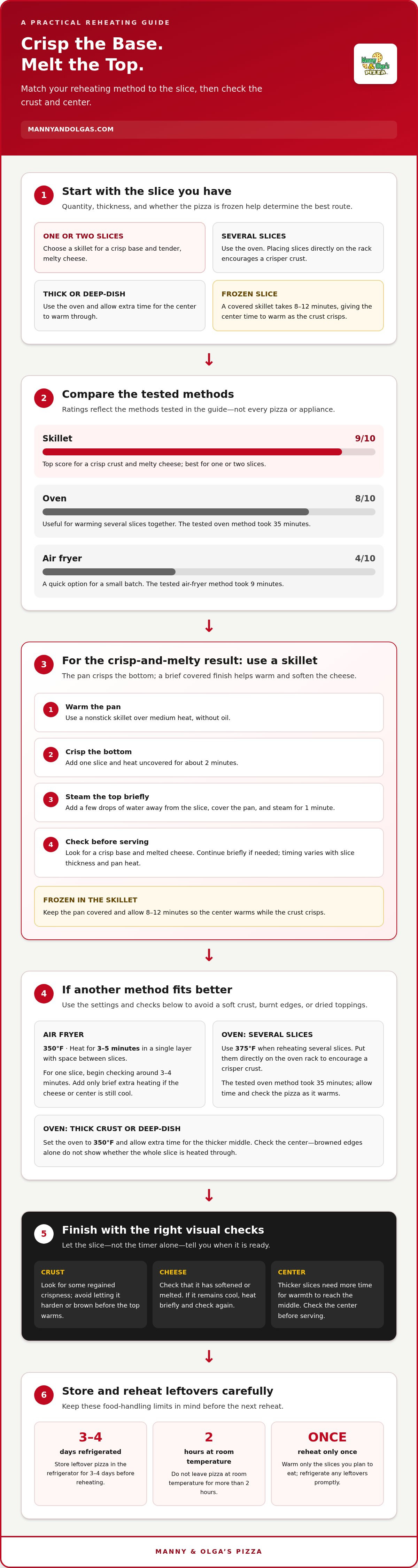
Choose a skillet for one or two slices when you want a crisp base and tender cheese. In testing, the skillet scored 9/10, compared with 8/10 for the oven and 4/10 for the air fryer. Those ratings reflect tested methods, not every pizza or appliance.
Use the oven when you’re warming several slices together, but allow time: the tested oven method took 35 minutes. An air fryer suits a quick, small batch, though its tested method scored lower. Check the crust and cheese as they warm, rather than relying on a rating alone.
-
Understand why skillet reheating works
Set the slice in a skillet so direct heat warms and crisps the bottom crust. Add a few drops of water away from the slice, then cover the pan briefly. The trapped steam helps soften the cheese and keeps toppings from drying out while the crust crisps against the pan.
Use medium or medium-low heat, and don’t leave the slice uncovered for too long. A hot, uncovered pan can brown the base before the top warms. For a different texture, you could try cooking the slice cheese-side down in a nonstick skillet, then carefully flipping it.
-
Reheat pizza using the best skillet method
Warm a nonstick skillet over medium heat without oil, then add one slice. Heat uncovered for about two minutes to crisp the bottom. Add a few drops of water away from the slice, cover the pan, and steam for one minute to soften the cheese.
Check that the base feels crisp and the cheese has melted; continue briefly if needed. The skillet method can take more or less time depending on slice thickness and pan heat. This is the best way to reheat pizza when you’re preparing a small serving and want crisp crust without drying the toppings.
-
Reheat deep-dish or thick-crust pizza
Use an oven for a deep-dish or thick-crust slice so its center can warm evenly. Set the oven to 350°F and allow extra time for the thicker middle. Check the center before serving, since a browned edge alone doesn’t show whether the whole slice has heated through.
A skillet can crisp a thick slice’s base, but gentle heat and a covered finish matter more than speed. If the crust browns before the center warms, switch to the oven. Choose based on slice thickness, not just toppings.
Store leftover pizza in the refrigerator for 3-4 days before reheating, and don’t leave it at room temperature for more than 2 hours. For a safer reheat, warm only the slices you plan to eat, using a skillet or oven until the cheese and center are hot.
Reheating pizza in an air fryer
An air fryer can warm leftover pizza quickly by circulating heat around the crust. Use a moderate temperature, arrange slices with space between them, and check early to prevent over-browning.
-
Set the air-fryer temperature
Set the air fryer to 350°F before adding refrigerated pizza. This temperature warms the cheese while giving the crust time to crisp without scorching the toppings. Keep the setting steady rather than turning the heat higher to hurry the process.
Arrange slices in a single layer without overlap. Space allows hot air to circulate and warm each piece more evenly. If the basket fits only one slice comfortably, cook the slices in separate batches rather than stacking them.
-
Heat the pizza in the air fryer
Place the slices in the basket and heat them for 3-5 minutes. For a single slice, begin checking around 3-4 minutes, since thinner pieces can warm sooner. The tested air-fryer method took 9 minutes, but your slice’s thickness and appliance affect its timing.
Look for softened cheese and a warm center before serving. If the crust is crisp but the toppings still feel cool, heat briefly and check again. Don’t automatically add several minutes, since a thin slice can dry out quickly.
- Check the basket after the first heating interval, especially if the slices are different thicknesses. A thin slice may finish before a thick one, so remove ready pieces and return the thicker slice to heat. This helps keep the thin crust from hardening while the thicker slice warms through.
Use tongs or a spatula to lift a slice for checking. The basket and crust will be hot, so avoid touching the slice with bare fingers. Keep toppings level as you move it, since melted cheese can slide when a slice bends.
- Heat only the leftovers you plan to eat, then serve them once warmed. An air fryer works well for a small batch that fits in one layer. Crowding the basket blocks airflow and can leave some spots unevenly heated.
For multiple slices, cook in batches rather than stacking them. Let the basket return to its normal position between batches, and use the same 350°F setting. Check each batch as it finishes, since a fuller load may warm differently from one slice.
- Adjust your checks to the slice, not just the timer. A thin crust needs less heating than a thick, heavily topped piece, which takes longer for warmth to reach the center. Start within the 3-5-minute window, then add brief intervals only when the cheese or middle remains cool.
Remove the pizza when the cheese is soft and the crust has regained some crispness. Leaving it in longer can dry out the toppings and toughen the base. Check its appearance and center instead of relying on time alone.
Using an oven rack, baking sheet, or pizza stone
Use a conventional oven to warm several slices at once. Choose the cooking surface based on whether you prefer a crisp or softer crust.
-
Choose an oven rack, baking sheet, or pizza stone
Place slices directly on the oven rack for air circulation around the crust. Put foil underneath to catch drips without compromising crispness. For a softer base, use a baking sheet instead, which separates the pizza from the rack’s direct heat.
For a crisp finish, use a preheated pizza stone or steel. Set the slices on the hot surface carefully, and allow room between them so heat can reach the edges. A stone or steel reheats pizza at 375-400°F for 5-8 minutes.
-
Set the oven temperature
Set a conventional oven to 375°F for most refrigerated leftovers. This middle-ground temperature warms the cheese and crust without requiring the high heat used to bake a fresh pizza. Let the oven reach its setting before placing slices inside, especially when using a baking sheet or rack.
For deep-dish pizza, choose 350°F and allow extra time for the center to heat evenly. A thicker slice needs more time in the oven than a thin one, so don’t judge readiness by the browned edge alone. Check the middle before serving.
-
Heat the pizza in the oven
Arrange slices in a single layer, then heat most leftovers at 375°F for 8-12 minutes. Thin-crust slices may be ready after 6-8 minutes. Start checking at the shorter time, particularly with thin pieces, to avoid over-baking the crust or drying the toppings.
Check for softened cheese and a warm center before removing the pizza. If the edges brown before the cheese is ready, loosely cover the slices with foil to help prevent over-browning as they continue to heat.
- Choose the oven surface to suit the texture you want: use the rack for a crisper crust or a baking sheet for a softer one. A thin slice on the rack gets air circulation around its base, while the sheet provides a barrier from the rack.
Place foil beneath the rack if toppings might drip, but don’t wrap the pizza for the entire reheating process. Leave space between slices, and cover them loosely only if the cheese begins browning too quickly.
- Set a timer for the lower end of the recommended window, then inspect the crust and center. A thin slice can finish in 6-8 minutes, while a typical leftover slice may need 8-12 minutes at 375°F. Remove ready slices as you go instead of leaving them in until every piece is done.
Use a preheated stone only when you can transfer slices safely onto its hot surface. Its 375-400°F range and 5-8-minute heating window differs from the conventional oven method. Avoid moving a hot stone while the pizza is cooking.
Avoiding soggy, burnt, chewy, or dry pizza
Control heat and timing to protect the crust, cheese, and toppings. When using a microwave, lower power and brief checks can help limit a soggy base.
-
Prevent soggy crust in the microwave
Set the microwave to 50% power and heat one slice for 30-45 seconds, then check it. Add time in short bursts only if the center remains cool. Full power can heat unevenly, leaving the cheese hot while the crust turns soft and chewy.
A microwave can warm pizza, but it won’t crisp the bottom like a skillet or oven. In testing, the microwave method scored 2/10. Choose it for speed, then transfer the slice to a hot skillet if a crisp crust matters more than convenience.
-
Avoid burnt, chewy, or dry pizza
Check the cheese and crust before adding more heating time. If the cheese is bubbling or the edge is darkening, remove the slice rather than continuing to cook it. For an oven batch, loosely cover the slices with foil if the cheese browns before the centers warm.
Use the suggested temperature and time as a starting point, then account for slice thickness. A thin slice can dry out while a thick center is still warming. Remove finished slices one at a time instead of leaving them with pieces that need longer.
- Choose a method based on the texture you want. A skillet crisps the bottom, and a covered finish softens the cheese; an oven warms several slices together. A microwave is convenient, but it can leave the crust soft and chewy, so keep heating brief.
Don’t raise the temperature just to shorten the wait. Higher heat can brown the outside before the center warms. Check the pizza as it heats, especially when slices differ in thickness or toppings.
- Warm chilled pizza until it reaches 140°F to temporarily reverse crust staling. Use a food thermometer to check the center rather than judging only by melted cheese or a hot edge. Once the slice reaches that temperature, serve it instead of continuing to heat it.
The temperature can temporarily improve the crust’s texture, but the reheating method still matters. A skillet, for example, brings the base into direct contact with heat, while a microwave can leave it soft. Match the method to the result you want.
- Heat only the slices you plan to eat, and check each one as it warms. A thin slice may need less time than a thick, heavily topped piece. Brief checks help prevent overcooking in a microwave, skillet, or oven.
For a fast microwave reheat, begin at 30 seconds on 50% power and inspect the center. Continue only if needed, stopping once it’s warm. If crispness is the priority, use a skillet or oven rather than extending microwave time.
Reheating frozen pizza
Frozen slices need time for the center to warm, not just the toppings to soften. Choose a covered skillet, air fryer, oven, or microwave according to your preferred crust and available equipment.
- Choose a covered skillet for a crisp bottom and tender toppings. Set the frozen slice in the pan, cover it, and heat for 8-12 minutes. The lid traps steam to warm the cheese while the skillet crisps the crust. Check the center before serving, especially on a thick slice.
- Use an air fryer when you want a crisp finish without heating a full oven. Set it to 350°F and heat the frozen slice for 5-8 minutes. Arrange slices in a single layer so hot air reaches each piece. Check the middle and cheese before taking the pizza out.
- Choose the oven for a thicker slice or when warming several pieces. Heat frozen pizza at 375-400°F for 12-18 minutes, depending on thickness. Start checking before the end of that window: a thin slice may finish sooner, while a thick center needs more time. Remove each slice once its center is hot and toppings are warmed.
- Use the microwave when speed matters more than a crispy crust. Heat frozen slices on medium power for 1-2 minutes, then check the center. Microwave heating can soften the bottom, so avoid automatically using the full time if a thinner piece warms quickly. For more crispness, finish the slice in a skillet.
- Match the method to the slice and the texture you want. Choose a covered skillet when crust texture matters, an air fryer for a compact, crisp reheat, or an oven for a thicker piece. Treat the suggested times as starting points, since thickness affects how quickly heat reaches the center.
- Check the cheese, center, and crust before serving instead of judging by bubbling toppings alone. If the top looks ready but the middle is cold, continue heating with the same method and check again. Don’t stack slices, since crowded pieces heat less evenly.
Ready for a freshly made slice instead? Explore pizza options for your next meal.
Manny & Olga’s Pizza: Cheese Pizza
Manny & Olga’s Pizza is a natural next step when you’re craving a fresh slice instead of reheating leftovers. Choose Cheese Pizza for a classic combination of warm cheese and familiar pizza flavor, or pick Pepperoni Pizza, Manny’s Special Pizza, or Meat Lovers Pizza for a heartier bite.
Reheating can bring yesterday’s slice back to the table, but freshly prepared pizza is another way to satisfy a craving. Choose Cheese Pizza for a straightforward favorite or pick another pie to suit your taste. Manny & Olga’s offers easy ordering online, by text, or by phone.
Visit Manny & Olga’s Pizza to explore the menu and plan your next pizza meal.
Make Your Next Pizza Moment Delicious
A good meal can be as simple as enjoying a familiar favorite or choosing something different for the table. Keep the best way to reheat pizza in mind for leftovers, then let your next order be guided by the flavors you’re craving. Manny & Olga’s Pizza offers Cheese Pizza, Pepperoni Pizza, and Manny’s Special Pizza, giving you classic and heartier choices to consider.
Planning a casual meal or choosing what everyone might enjoy? Start with the pizza that sounds right, whether you prefer a simple cheese slice or a pie with plenty of toppings. When reheating isn’t the plan, order a fresh pizza from Manny & Olga’s for delivery or takeout.
Contact Manny & Olga’s Pizza to explore your options and plan your next pizza meal. Here’s to a delicious next slice.
Frequently Asked Questions
What is the best way to reheat pizza in a skillet?
Warm a nonstick skillet over medium heat, then place a slice inside without oil. Let the bottom crisp uncovered for about two minutes. Add a few drops of water away from the slice, cover the pan, and steam for a minute to soften the cheese. A 10-inch pan suits a single slice; use a second batch rather than crowding the pan.
How do you reheat pizza in an oven, and at what temperature and for how long?
Heat a conventional oven to 375°F and warm most slices for 8-12 minutes. For thin crust, begin checking at 6 minutes, since it may finish within 6-8 minutes. Put slices directly on the rack for a crisper base, or use a baking sheet for a softer one. If cheese browns before the center warms, loosely cover the slices with foil.
How do you reheat pizza in an air fryer, and at what temperature and for how long?
Set the air fryer to 350°F and heat refrigerated slices for 3-5 minutes. Keep each piece in a single layer, leaving space around it so hot air can circulate. Start checking after 3 minutes, especially for a thin slice or a small appliance basket. Remove each piece once its cheese is soft and its center is warm, rather than leaving every slice in for the same time.
Which method reheats pizza fastest while keeping the crust crisp and cheese melted?
For one or two slices, the best way to reheat pizza for both a crisp base and melted cheese is usually a skillet. It takes about 4-7 minutes, using direct pan heat for the crust and a brief covered steam to warm the top. An air fryer may take 3-5 minutes, but the skillet method gives you more direct control over the crust and cheese together.
How do you reheat frozen leftover pizza?
For a frozen slice, choose the appliance that fits your time and texture preference: use a covered skillet for 8-12 minutes, an air fryer at 350°F for 5-8 minutes, or an oven at 375-400°F for 12-18 minutes. Thickness affects how soon the middle warms. Check the center before serving, and avoid stacking slices so heat can reach each piece evenly.


