
A golden top can hide a cold center. You can freeze baked ziti before baking or freeze it after baking, as long as you wrap it well; reheat it covered with a little moisture to help keep it tender. The proper way to store and reheat baked ziti leftovers also includes checking that the center reaches 165 degrees F.
Leftover baked ziti should be comforting, saucy, and hot throughout, not dried around the edges or cold in the middle. This guide covers how to refrigerate or freeze it, how to reheat a full dish or a single portion, and why checking the center matters so every serving is satisfying.
Key Takeaways
- Choose whether to freeze baked ziti before or after baking based on when you plan to serve it.
- Cool the dish, portion it if useful, and wrap it securely to help protect its texture in the freezer.
- Reheat a full dish covered in the oven; use shorter, gentler heating for individual portions.
- Add a little moisture before reheating to help keep the pasta and cheese from drying out.
- Check the center before serving so the ziti is hot all the way through.
Do you freeze baked ziti before or after baking?
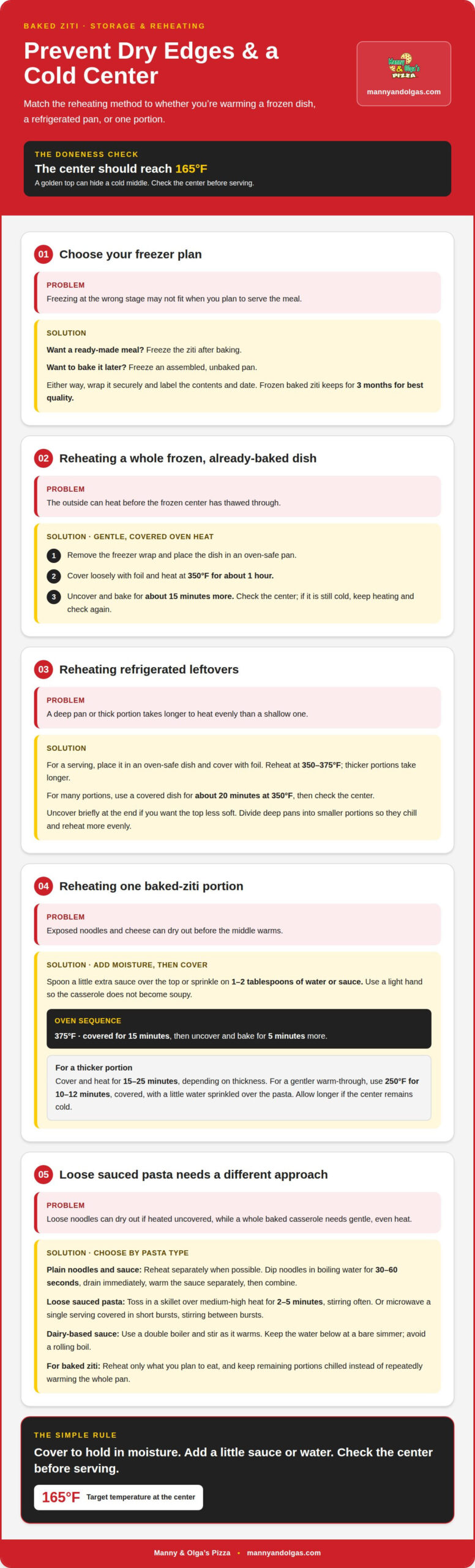
- Choose based on when you’ll serve it. Freeze baked ziti after baking when you want a ready-made meal to reheat; freeze an assembled, unbaked pan when you want to bake it later. Either way, wrap the dish securely and label it with its contents and date. Frozen baked ziti keeps for 3 months for best quality.
- Refrigerate cooked leftovers promptly in a covered container, and keep the refrigerator consistently cold. Properly stored leftover pasta lasts up to five days in the refrigerator. Divide a deep pan into smaller portions so it chills and reheats more evenly.
- Thaw a frozen pan in the refrigerator before baking or reheating. Keep it covered while it thaws, and place it where any tomato sauce or melted cheese can’t drip onto other food. If you’re short on time, you can reheat cooked baked ziti directly from frozen in the oven instead.
- For frozen, already-baked ziti, remove the freezer wrap and set the dish in an oven-safe pan. Cover it loosely with foil and heat at 350 degrees F for about an hour, allowing time for the center to thaw and warm. Uncover the dish and bake for about 15 minutes more. If the center remains cold, continue heating and check again.
- For refrigerated baked ziti leftovers, place a serving in an oven-safe dish and cover it with foil. Reheat at 350–375°F; a thick portion takes longer than a shallow one. For many portions, use a covered dish and allow about 20 minutes at 350°F, then check the center. Uncover briefly at the end if you want the top less soft.
- Uncooked frozen ziti needs a different oven schedule from cooked leftovers. Remove its freezer wrap, cover the pan loosely with foil, and bake at 350 degrees until bubbly; one method takes 65–75 minutes, uncovering for the final 10 minutes. Don’t use this longer baking time for a small serving of already-cooked ziti.
- Treat baked ziti differently from loose sauced pasta. A whole baked dish reheats well in the oven, while loose pasta with tomato sauce can dry out if heated uncovered. Reheat only what you plan to eat instead of warming the whole pan repeatedly. Keep the remaining portions chilled for another meal.
How reheating methods differ for baked and sauced pasta
A baked casserole needs gentle, even heat, while loose noodles need quick warming and movement. Choose the method based on the pasta’s texture and how much you’re reheating.
-
Separate the Pasta and Sauce
Reheat plain noodles separately from their sauce when you can, so they don’t soften while the sauce warms. Dip the noodles in boiling water for 30 to 60 seconds, then drain immediately. That short bath warms them without leaving them waterlogged.
Warm the sauce in a separate pan, then combine it with the drained pasta just before serving. For loose sauced pasta, toss the noodles and sauce together in a skillet over medium-high heat for two to five minutes, until heated through. Stir often so the sauce warms evenly and doesn’t stick.
-
Add Sauce or Water
Before reheating a baked-ziti portion, spoon a little extra sauce over the top or sprinkle on 1–2 tablespoons of water or sauce. The added moisture helps protect exposed noodles and cheese as heat moves through the center. Use a light hand: too much liquid can make the casserole soupy instead of pleasantly saucy.
For sauced pasta in the microwave, add 3 tablespoons of water, cover the dish, and heat in short bursts. Stir between bursts so cooler noodles from the middle move toward the edges. A skillet works too: add 1–2 tablespoons of water or stock per serving, cover for 1–2 minutes to create steam, then stir and continue warming.
-
Cover Portions with Foil
Place a baked-ziti portion in an oven-safe baking dish, add sauce over the top, and cover the dish with foil. Heat at 375°F for 15 minutes, then uncover and bake for another 5 minutes. The cover holds in moisture; uncovering briefly lets the top regain some texture.
For a thicker casserole portion, cover it and allow 15–25 minutes in the oven, depending on its thickness. A gentler option is 250°F for 10–12 minutes, covered with foil and a little water sprinkled over the pasta. Choose a lower temperature when you want a slower warm-through, and allow longer if the center remains cold.
- Use a double boiler for a dairy-based sauce that scorches easily in a pan. Put the sauce in the upper bowl and keep the water below at a bare simmer. Stir as the sauce warms, then toss it with the noodles. Avoid a rolling boil, which can overheat the sauce before the pasta is ready.
- Use the microwave for a single serving of sauced pasta, not a whole casserole. Cover the portion, heat briefly, stir, and repeat until it’s warmed through. For baked ziti, use an oven-safe dish in the oven if you want to keep the cheese topping intact. Matching the method to the dish helps keep noodles tender and sauce smooth.
Wrapping and labeling baked ziti for the freezer
Cool the pasta dish, choose freezer-safe packaging, then seal and label each portion before freezing. A clear label makes it easier to plan thawing and reheating.
-
Cool Baked Ziti Before Freezing
Let baked ziti cool uncovered at room temperature for 20–30 minutes before freezing. Keep it on a stable surface, away from other food, and don’t leave it out longer than needed. Divide a large pasta dish into smaller portions so it cools more evenly and is easier to package.
Refrigerate leftovers promptly after baking. Use the brief cooling period to divide the ziti into portions for chilling or freezing, but don’t put a hot baking dish directly into the freezer. Steam trapped under a tight cover can create condensation, leaving the pasta and sauce wetter after thawing.
-
Choose Containers for Storage
Use a freezer-safe baking dish for a whole casserole or airtight, freezer-safe containers for individual portions. Leave a little room at the top, since pasta and sauce can expand as they freeze. Shallow containers make it easier to divide the ziti and thaw only the amount you plan to eat.
If you’re freezing the ziti in its baking dish, cover it once cooled with a double layer of heavy-duty foil. Press the foil around the rim to limit air exposure, then add a lid if the dish has one. A loose covering can shift in the freezer.
-
Note the Freezer Storage Duration
Write the contents and freezing date on a label before the container goes into the freezer. Baked ziti stored in a freezer-safe dish can last at least 6 months when properly wrapped; for best quality, plan to use it within 3 months. The label helps you rotate older portions first.
If you won’t use leftover pasta sauce with the ziti, freeze it separately in a sealed, freezer-safe container. Leave room at the top, label the sauce and date, and thaw it alongside the pasta when needed. Keeping sauce separate lets you add it to a portion as you reheat.
- Keep the refrigerator consistently cold for chilled leftovers. No exact refrigerator setting is included in the available figures, so don’t rely on an invented temperature; use a steady cold setting and store the ziti covered. Properly stored leftover pasta lasts up to five days in the refrigerator.
- After a brief cooling period, move baked ziti into the refrigerator or freezer instead of leaving it on the counter. Once cooled, seal and label portions before freezing. The label keeps the freezer organized and makes it easy to choose which dish to thaw first.
Preventing pasta from drying out during reheating
Use smaller portions, add moisture, and match the heat to the pasta. The best method depends on whether you’re warming baked ziti, sauced noodles, or plain pasta.
-
Understand Changes in Leftover Pasta Texture
Pasta from the refrigerator may feel firmer than it did when fresh. As cooked pasta cools, its starches reorganize in a process called starch retrogradation. This can make noodles seem dry or less tender, even when they still have sauce on them.
Reheat only the portion you plan to eat, and add moisture before heating. For baked ziti, sprinkle 1–2 tablespoons of water or sauce over the top. Don’t use extra heat to force the texture back; a longer, hotter cook can dry the exposed pasta and cheese. This small adjustment is part of the proper way to store and reheat baked ziti leftovers.
-
Reheat Pasta in the Microwave
Put a small portion in a microwave-safe dish and add 1–2 tablespoons of water, stock, or cream. Cover the dish, then heat for 30–45 seconds at a time, stirring between bursts. This helps moisture spread through the noodles instead of leaving the edges hot and the center cool.
After the first bursts, continue in 15–30-second intervals until hot. For a single portion, start with 1 to 1½ minutes, then check and stir before adding more time. Don’t microwave a whole frozen baking dish this way; the microwave works best for smaller pieces.
- For sauced pasta on the stovetop, warm it over medium heat with 3 tablespoons of water. Stir as the sauce loosens, usually within a minute or two, and stop once the pasta is heated through. Keep the pan moving; leaving noodles untouched can let sauce stick while the top dries.
- Sauté one serving of sauced pasta over medium-high heat for two to five minutes, stirring until heated through. Add 1–2 tablespoons of water or stock per serving if the sauce looks thick. Cover the skillet for 1–2 minutes to trap steam, then uncover and stir.
- For plain pasta without sauce, dunk the noodles in warm water for about one minute, then drain immediately. Don’t leave them in the water, or they can turn soggy. Thaw frozen pasta before using this quick method, since a cold, solid clump won’t warm evenly.
- Use an oven for a larger piece of baked pasta, but keep the portion covered and add 1–2 tablespoons of water or sauce first. Oven degrees alone won’t prevent dryness: portion size, thickness, and moisture matter too. A smaller piece warms faster than a deep casserole, so check it before extending the heating time. For a full guide to the proper way to store and reheat baked ziti leftovers, tailor the method to the portion you’re serving.
Checking that baked ziti is hot in the center
A browned top doesn’t mean the center is ready. Check the thickest part of the dish, where cold spots can remain after reheating.
- Use a food thermometer to check the center of the baked ziti. Insert its tip into the thickest area, avoiding the baking dish beneath it. The target is 165 degrees F internally. A bubbling tomato sauce or melted cheese can look ready before the middle reaches that temperature.
- Test more than one spot in a large casserole. Check the center and another thick area away from the edges, since oven heat can warm the outside first. For a single portion, place the thermometer into its middle. If the readings differ, keep heating until the coolest checked spot reaches 165 degrees F.
- Keep the dish covered while the center warms. Foil helps limit surface drying in the oven while heat reaches the middle. For a microwave portion, stir when possible, then check the center. If the edge is hot but the middle is cool, it needs more heating.
- If the ziti is still cool in the center, return it to the oven or microwave using the same method. Heat it in short intervals and check the center again instead of judging by the top’s color. A deep dish takes longer to heat through than a shallow portion, so use the temperature reading to guide the next step.
- Check portions separately after dividing a casserole. Pieces can vary in thickness, and a small serving may heat faster than a dense scoop. Check the center of the largest portion first, then check smaller servings as needed. One reading doesn’t necessarily cover every portion.
- Serve the ziti immediately after confirming its center reaches 165 degrees F. If you’re following a recipe for frozen or refrigerated pasta, treat its suggested cooking time as a starting point, not proof that the middle is hot. Oven temperature, dish depth, and portion size all affect how quickly heat travels through the pasta.
- Use a thermometer as part of your reheating routine, whether the ziti came from the refrigerator or freezer. Bubbling sauce, steam, and stretchy cheese show that the dish is warming, but they don’t replace a center reading. Check the thickest spot before serving.
Manny & Olga’s Pizza: Baked Ziti with Beef
Manny & Olga’s Pizza offers Baked Ziti with Beef when you want a hearty pasta dinner without preparing a pan at home. It’s a convenient next step if you’d rather enjoy a ready-to-eat meal than cool, wrap, freeze, and reheat leftovers. Choose delivery or carryout, then settle in for baked pasta with beef and a comforting, saucy finish. If you’re feeding different appetites, Cheese Pizza, Pepperoni Pizza, Manny’s Special Pizza, and Meat Lovers Pizza offer other familiar choices. For a meal that skips the leftover routine, contact Manny & Olga’s Pizza to order Baked Ziti with Beef.
Make your next meal easier
Leftovers can simplify tomorrow’s dinner, while a fresh meal can take one more task off today’s list. Knowing the proper way to store and reheat baked ziti leftovers helps you choose what works for your plans and avoid wasting a good meal.
If you’d rather skip the prep and cleanup, Manny & Olga’s Pizza offers another option for pasta night. Choose what suits your appetite and schedule, then enjoy a warm, satisfying meal.
Get in touch with Manny & Olga’s Pizza to plan your next meal. Enjoy dinner your way, whether you’re saving a portion for later or ready to tuck into something freshly prepared.
Manny & Olga’s Pizza for Baked Ziti
Manny & Olga’s Pizza offers Baked Ziti with Beef, along with other Italian dishes such as Stuffed Shells and Chicken Parmesan with Spaghetti.
Once you’ve stored and reheated your leftovers, turn to Manny & Olga’s Pizza when you’d like baked ziti or another Italian dish. Catering and party platters are also available.
Frequently Asked Questions
Can baked ziti be frozen, and how long does it keep?
Yes, baked ziti can be frozen before or after baking, and a practical target is to use it within 3 months. For example, freeze a fully baked casserole when you want to reheat ready-made portions, or freeze an unbaked assembled dish for later baking. Mark the container with its contents and freezing date. Thaw frozen ziti in the refrigerator before reheating when you have time to plan ahead.
What oven temperature and time are best for reheating baked ziti?
For refrigerated baked ziti, heat a covered oven-safe portion at 350°F for about 20 minutes, then check its center. A deep, family-size dish may need longer than a shallow serving, so use the internal temperature rather than the clock alone. If the pasta is frozen, it takes substantially longer; keep it covered while warming, then uncover briefly near the end if you want the top less soft.
How do you reheat baked ziti in a microwave without drying it out?
Add 1–2 tablespoons of water or sauce to a single portion, cover it, and microwave in 30–45-second bursts. Stir between bursts when the portion allows, then continue in short intervals until hot. For a piece with a cheese topping, place it in a microwave-safe dish and avoid overheating the edges while the center warms. A whole casserole is better suited to the oven than the microwave.
What internal temperature should reheated baked ziti reach?
Check that the center reaches 165°F before serving. Insert a food thermometer into the thickest part of the portion without touching the dish; a bubbling tomato sauce or melted cheese doesn’t show the center’s temperature. For a large casserole, take another reading in a separate thick area. If either spot is below 165°F, continue reheating and check again before serving.
Can baked ziti be reheated more than once safely?
Reheat only the portion you plan to eat rather than warming the whole pan repeatedly, and keep the remaining portions chilled.


