
A school-business partnership can do more than support a single event. Strong school partnering brings students, families, educators, and local organizations together around shared goals, connecting classroom learning with the wider community.
What makes a partnership useful beyond a one-time visit or fundraiser? A clear purpose, open communication, and expectations that work for everyone involved. Families and schools can share ideas and decisions, while community partners contribute resources, skills, and opportunities for students to learn.
This guide explores ways schools and businesses can collaborate, from engaging activities to practical agreements about roles and communication. It also explains how partnerships can continue through the school year, strengthen community connections, and make school events more welcoming. Whether you’re planning a first collaboration or giving an existing one more direction, start with shared expectations and focus on what students and the school community need.
Key Takeaways
- Choose activities that invite families to contribute in different ways, from volunteering to sharing traditions and supporting learning at home.
- Use partnership stories to see how local organizations can add learning opportunities and community resources to school life.
- Keep collaboration active across the school year with regular ways for partners, educators, and families to stay involved.
- Set expectations together, communicate clearly, and make room for families’ different schedules, backgrounds, and preferred ways to connect.
- Explore common partnership models to find an approach that fits students’ needs, school priorities, and community strengths.
Partnership activity examples
Families and community members can participate through school governance, committees, event volunteering, and regular conversations with educators. At home, caregivers can help with homework, talk about the school day, and share observations that help teachers understand each student.
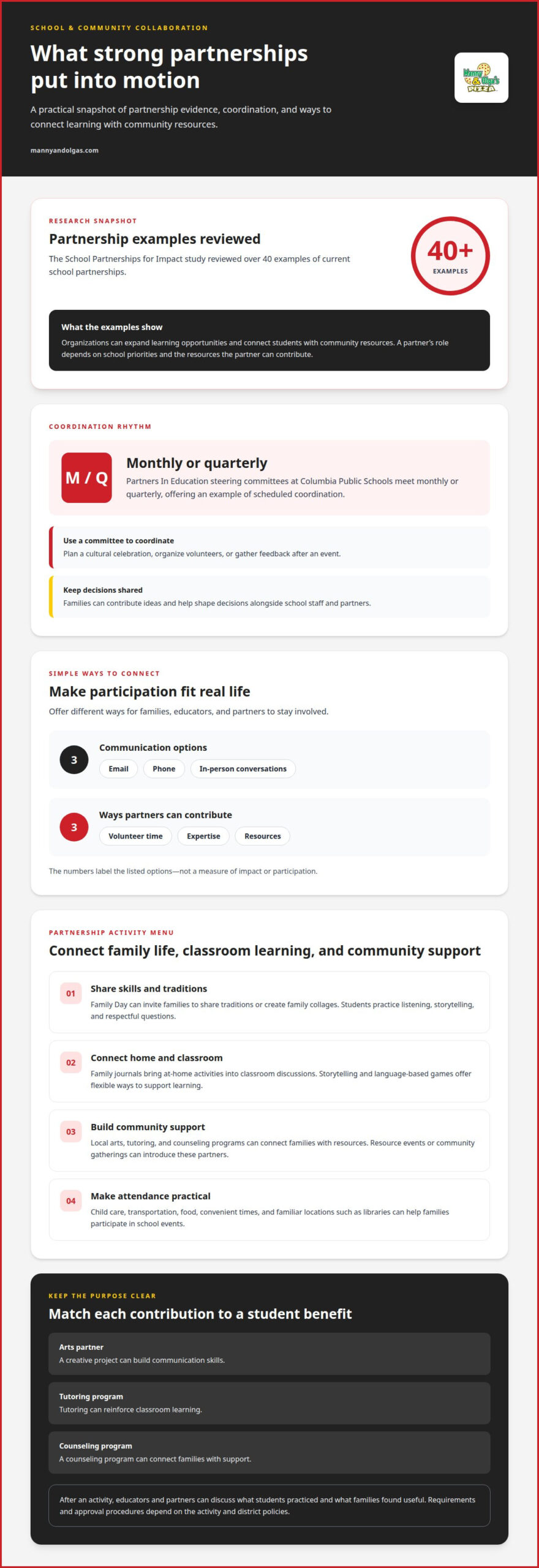
Activities work best when they offer several ways to take part. A caregiver with limited time might share a student’s interests, while another volunteers at an event or joins a committee. Schools can ask families how they prefer to communicate, then offer options such as email, phone, and in-person conversations. Clear, concise messages explain the activity and how to participate.
- Share skills and traditions: A Family Day can invite families to share traditions or create family collages. Students can use the activity to practice listening, storytelling, and respectful questions.
- Connect home and classroom: Family journals let students share at-home activities with their class. Storytelling and language-based games give families flexible ways to support learning.
- Build community support: Local arts, tutoring, and counseling programs can connect families with resources. A school can introduce these partners through a resource event or a community gathering.
- Make participation practical: Child care, transportation, and food can help families attend school events. Convenient times and locations, including familiar community spaces like libraries, can also make joining easier.
Caregiver-led workshops offer another way to get involved. Families might lead a session about a tradition, practical skill, or community resource, while school staff connect the topic to student learning. Asking for suggestions before planning helps ensure the session reflects family interests rather than assumptions. Translation services and bilingual staff can help more caregivers participate in discussions and activities.
School committees and event teams can turn a single activity into an ongoing role. Columbia Public Schools’ Partners In Education steering committees meet monthly or quarterly, providing an example of scheduled coordination. A school might use a committee to plan a cultural celebration, organize volunteers, or gather feedback after an event. Families can contribute ideas and help shape decisions.
Choose activities with a clear student benefit. An arts partner might lead a creative project that builds communication skills; a tutoring program can reinforce classroom learning; and a counseling program can connect families with support. After each activity, educators and partners can discuss what students practiced and what families found useful. This reflection helps shape future events around real needs and keeps community involvement connected to student success.
Homework activities offer another way to connect learning with family routines. They can accommodate different family circumstances and resources, with storytelling and games providing language-based options. Family Day can invite families to share traditions or create collages, while journals bring children’s activities at home into classroom discussions.
Partnerships benefit when families and school professionals exchange information through varied channels. Families may contribute through governance, committees or teams, event volunteering, conversations with educators, homework help, or talking with children about school. Schools can build relationships in familiar community spaces, such as community centers or libraries. For family events, provide child care, transportation, and food, and schedule activities at convenient times and locations.
School and business partnership stories
School-business partnerships connect student learning with community resources and practical experience. Examples show how organizations can contribute to school life in different ways.
Partnership Benefits
A school-business partnership links a school with an organization that contributes resources, expertise, or volunteer time. Students gain opportunities to learn beyond the classroom, while partners connect their work with community needs. A tutoring organization, for example, can reinforce classroom skills; a community group can help students explore arts or career interests. The value lies in matching each contribution to an educational purpose.
The School Partnerships for Impact study reviewed over 40 examples of current school partnerships. These examples illustrate how schools can work with organizations to expand learning opportunities and connect students with community resources. A partner’s contribution might add expertise to a classroom activity or help students access support services. The specific role depends on the school’s priorities and the partner’s resources.
Partnerships can also help organizations reach students who need support services and connect with school resources, including facilities, student data, and curriculum. These exchanges require clear roles and coordination. Schools can identify which resources are relevant to the activity, while partners explain what support they can contribute. A shared purpose helps both sides direct their efforts toward students’ needs.
There isn’t one set of legal requirements for every partnership activity in the United States. Applicable district policies and approval procedures depend on the activity and may address volunteers, school facilities, student information, and safety.
Funding and costs depend on the planned activity. Contributions may include volunteer time, expertise, materials, or other resources; partners can define responsibilities and funding arrangements to suit the work. A program that draws on community expertise, for example, differs from one requiring materials or additional coordination.
Finding and Assessing Potential Partners
Schools can find potential partners among local businesses, community organizations, and programs connected to student needs. Evaluate each option by asking how its contribution supports a school goal, which students it serves, and what coordination it requires. A written plan can clarify responsibilities, schedules, communication, and how the school and partner will review the activity’s value.
For example, a school aiming to reinforce a classroom skill might explore a tutoring partnership; one planning enrichment could consider an arts organization. Start with the student need, then match a partner’s knowledge or resources to it. This helps schools choose a useful program rather than treating every partnership as interchangeable.
Risks include unclear responsibilities, competing priorities, and activities that require more coordination than expected. Schools can reduce confusion by discussing the purpose, roles, student participation, and communication process before work begins. Regular conversations also help partners respond to changing needs and keep collaboration focused on student benefits.
School-year-long partnerships
A continuing partnership connects classroom learning with consistent community support. Rather than ending after one event, a school and partner can agree on activities that reinforce education throughout the school year. For example, a local arts organization might lead a project, then return to help students develop and present their work.
Continuity gives students repeated chances to practice skills, ask questions, and apply feedback. A tutoring partner can coordinate with educators to reinforce a classroom concept, then adjust activities as students progress. School-based partnerships can provide services over multiple years, while additional staff support and resources can help reinforce classroom learning.
A useful annual plan links each activity to a student need. At the start of the year, school staff and partners can set a shared goal, agree on roles, and map contributions to the school calendar. A reading partner, for instance, might support classroom practice during one term and later help students share completed work. Regular communication keeps activities connected to lessons.
- Set a shared purpose: Identify the student need and the partner’s contribution before activities begin.
- Plan the rhythm: Place partner visits, volunteer support, and school milestones on a common calendar.
- Review progress: Discuss student participation, work completion, and the next useful activity.
- Keep roles clear: Record who coordinates each visit, communicates changes, and supports students.
Columbia Public Schools defines a Partnership Friend as a person, community organization, or business making a yearly significant contribution of resources or volunteer time to a school, department, or classroom through its Partners in Education program. This definition emphasizes ongoing contribution rather than a one-time appearance. A partner can offer expertise, time, or resources that fit a school’s needs.
Schools can use a simple review cycle to keep collaboration meaningful. After an activity, educators and partners can note what students practiced, what support was useful, and what to change next time. If a project helped students build presentation skills, for example, a future session could give them another chance to explain their work to an audience.
Long-term collaboration can support attendance, engagement, work completion, study habits, achievement, and prosocial behavior. These outcomes relate to students’ experiences at school and at home, so communication with families matters. A teacher might share a learning goal, invite caregivers to reinforce it at home, and use later conversations to understand what is working for the student.
Partnerships can also grow as needs change. A school might begin with classroom support, then involve the same community partner in a student showcase or learning activity. Districts, schools, and partners can establish processes to coordinate and manage this work, allowing each new activity to build on earlier efforts rather than start from scratch.
Shared goals and expectations
A clear partnership plan connects school priorities with a partner’s contribution. In Washington, D.C., schools can use shared goals to guide decisions, communication, and student opportunities.
To create an agreement, start by naming the student need and the outcome both parties want. Invite school staff, families, and the partner to shape the goal together. Then define each participant’s role, planned activities, communication methods, and available resources. Record how decisions will be made and when the group will review progress. Share the agreed plan with everyone involved.
- State the goal: For example, identify a shared aim to improve students’ study habits.
- Describe responsibilities: Clarify who coordinates activities, communicates changes, and supports students.
- Set communication practices: Ask families whether they prefer email, phone, or in-person contact.
- Plan review points: Agree how the group will discuss progress and adjust activities.
These steps create a working agreement, not a one-size-fits-all legal template. The right details depend on the activity. A classroom learning project calls for different roles than a family event or community resource activity. Clear expectations help prevent confusion about who leads, how families participate, and what happens when plans change.
Measure success by linking the partnership’s goal to observable student outcomes. If the goal is stronger study habits, review work completion and student engagement. For an attendance goal, consider attendance patterns; for academic support, examine achievement and progress. Schools and partners can also gather feedback from students, families, and educators to see whether activities feel relevant and accessible.
The Family-School Partnerships Framework highlights communication, connections between home and school learning, shared decision-making, and participation. These dimensions offer a practical way to examine school relationships. Partners can discuss whether families receive clear updates, have meaningful opportunities to contribute, and understand decisions affecting an activity.
Good communication strengthens shared expectations over time. Schools can keep messages concise, avoid jargon, translate communications when needed, and give families a way to ask questions. Starting with positive feedback before discussing challenges can make conversations more constructive. A teacher might first share a student’s progress, then invite caregivers to discuss a learning concern and possible support.
Goals should also reflect the community’s experience. At the start of the school year, a school can explain how families may participate while considering cultural factors and possible barriers. Staff can learn about students’ home and community experiences before shaping activities. If a family cannot attend an event, the school can offer another participation option, such as sharing feedback by phone or email.
Leadership can shift between families and school professionals depending on the situation. A caregiver may lead a conversation about a child’s experience, while educators guide a discussion about classroom learning. Making this flexibility explicit helps partners work toward shared outcomes and keeps student needs at the center.
What types of school partnerships are common in the United States?
U.S. schools use partnerships to connect students with families, businesses, and community organizations. The right model depends on whether the priority is learning, family collaboration, or access to support.
Family-school partnerships bring caregivers and school teams together around students’ academic, social-emotional, and behavioral needs. Families and educators share information, align strategies, and make decisions through transparent conversations. For example, a family can explain what helps a child stay focused at home, while a teacher describes classroom goals. Together, they can choose a useful way to support that student.
School-business partnerships connect a business with a school, department, or grade level. A business might contribute staff knowledge, resources, or volunteer time to enrich an educational program. The school’s purpose could be career awareness, practical learning, or added support for a classroom project. The strongest fit links the partner’s contribution to an identified student or school need.
- Community resource partnerships: Local organizations can connect families with services and opportunities beyond the school. A community center, for example, can provide a familiar setting for school-family conversations.
- Learning enrichment partnerships: Community organizations can add skills, perspectives, or experiences that complement classroom learning. An arts group might help students explore creative work through a school activity.
- School mental health partnerships: Family-school collaboration can be aligned with school mental health systems and practices. Families and school professionals can share relevant information and coordinate support around a student’s needs.
- Shared-decision partnerships: Families and educators can decide together how to address a learning or engagement concern. The process works best when each party can contribute information and understand the resulting decision.
These models can overlap. A community organization may enrich learning while helping families connect with resources; a business may contribute expertise while supporting a school-wide goal. The school and partner can define roles for the activity, explain how families can participate, and agree on communication. That clarity keeps collaboration focused on students rather than an organization’s visibility or a one-time event.
Consider the purpose before choosing a model. If a student needs coordinated support, family-school collaboration may be central. If the school wants to broaden learning experiences, a business or community organization may contribute useful expertise. If families need better access to services, a community resource partnership may fit. A school can also combine approaches, provided participants understand their roles and share the goal.
For a school community event that brings families and local partners together, plan a shared gathering as one way to support participation.
Collaboration is ongoing: families and school professionals share power, reduce hierarchies, listen, support one another, communicate both ways, make transparent decisions together, share outcomes with all parties, and support a child’s academic and personal growth.
Manny & Olga’s Pizza
Manny & Olga’s Pizza can help schools plan food for a family event, student gathering, or community activity. Catering gives organizers a practical meal option while they focus on the partnership’s purpose, schedule, and participants.
Choose from Cheese Pizza, Pepperoni Pizza, Manny’s Special Pizza, or Meat Lovers Pizza to suit the gathering. A shared meal can give students, families, educators, and community partners time to connect before or after an activity. Include the food plan in event coordination so organizers can align it with the event format and school expectations.
For a school partnership event that needs a straightforward meal option, contact Manny & Olga’s Pizza about catering.
Make Your Next School Gathering Count
Make the next school event a welcoming space for students, families, educators, and community partners to connect. A shared meal can complement a workshop, student celebration, or family gathering while the partnership’s purpose stays at the center. Choose a format that suits your community and make the meal one practical part of the experience.
For school partnering, Manny & Olga’s Pizza can provide catering for a school or community gathering. Cheese Pizza, Pepperoni Pizza, and Manny’s Special Pizza are familiar options for a group meal. Plan the food around the event’s format and attendees, and keep the focus on making the gathering comfortable and enjoyable.
Contact Manny & Olga’s Pizza to discuss catering for your school gathering. Bring your community together, share a meal, and make room for the conversations that help a partnership move forward.
School partnering with Manny & Olga’s Pizza
Manny & Olga’s Pizza can provide food for school gatherings, celebrations, and other events where shared meals or snacks are part of the plan. Once you know the occasion and what food you need, consider the catering and party platters.
Choose pizzas such as Cheese, Pepperoni, Veggie Lovers, or Gluten Free, along with subs, salads, wings, and other menu options. For a school event, select items that suit the group and the gathering.
Frequently Asked Questions
What does school partnering mean?
School partnering means a school works with families or community organizations to support students’ learning and well-being. For example, a neighborhood arts group might collaborate with a school on a student project, while caregivers share what topics engage their children at home. The partnership links people’s contributions to a common purpose, rather than treating each activity as an isolated visit. School partnering can take different forms as students’ needs evolve.


