
Thirty people can turn a pizza order into a guessing game, but a typical adult gathering calls for 12 to 15 large pizzas. If you’re working out how many pizzas for 30 people, use that range as your starting point, then adjust for appetite and the kind of meal you’re serving.
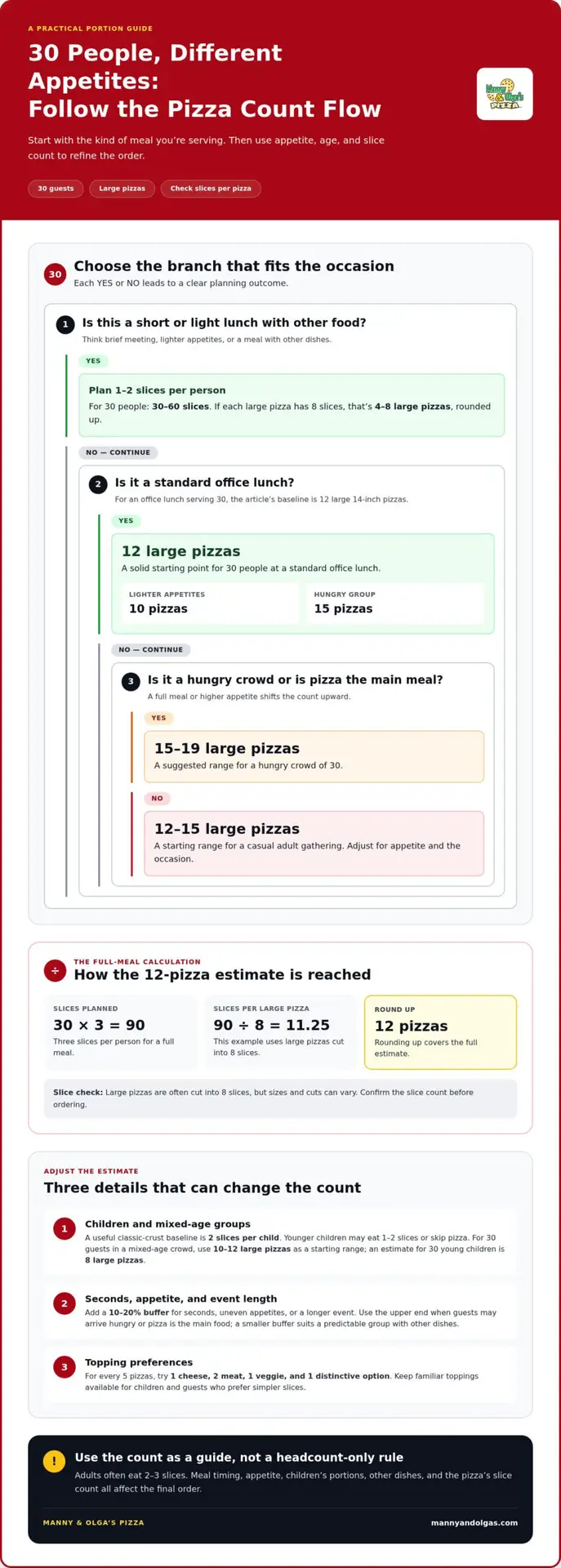
It’s easy to count guests and miss the details that change the order: a light office lunch isn’t the same as a hungry crowd settling in for dinner, and children often eat less than adults. For an office lunch, 12 large 14-inch pizzas is a solid baseline; lighter appetites may need less, while hungry guests may need more.
This guide explains how to estimate slices and round up to a useful pizza count, choose sizes without getting tripped up by different slice counts, and adjust portions for children, adults, and big appetites. You’ll also see when pizza can carry a meeting on its own and when salads or other sides make a lighter lunch feel complete. Plan with the people and occasion in mind, and you can serve plenty of hot, fresh slices without ordering blindly.
Key Takeaways
- Use 12-15 large pizzas as a starting range for a casual adult gathering, then adjust for how hungry guests are.
- For a mixed-age group, account for children’s smaller portions and adjust the total to suit the guests’ appetites.
- Estimate slices first, divide by the slices per pizza, and round the final count up to avoid coming up short.
- Check pizza size and slice count before ordering, since a large pizza is often cut into 8 slices but sizes and cuts can vary.
- For a light office lunch or short meeting, plan around 1-2 slices per person and consider sides to round out the meal.
Adjusting quantities for mixed-age groups
For a group with children and adults, start by estimating slices by age and appetite. A useful baseline for classic-crust pizza is two slices per child, while adults often need a larger share. For 30 guests in a mixed-age crowd, plan on 10-12 large pizzas, then adjust for how many children will eat and whether pizza is the main meal.
Younger children may eat one or two slices, and some may choose just a slice or skip pizza. That makes a headcount alone less useful than a quick age-and-appetite estimate. For example, if several guests are young children, count their likely slices separately before estimating the adults’ portions. A group of 30 young children has an estimate of 8 large pizzas, while a mixed crowd may need more.
For an easy calculation, use the pizza’s slice count. If a large pizza is cut into 8 slices, divide the total slices needed by 8 and round up. This keeps the estimate tied to actual portions rather than assuming every guest eats the same amount. For 30 people, the estimate changes with the group: 8 large pizzas suit lighter appetites, while 15 large pizzas are suggested for a hungry crowd.
Think about the gathering, too. At a casual adult event, appetites may vary; a meal during a regular mealtime usually calls for more than a brief snack. For a group with children, the 10-12 large-pizza range offers a practical starting point. Shift toward the lower end when children make up much of the group, and toward the upper end when adults are hungry or pizza is the main food.
A mix of toppings helps guests find something they enjoy without making every pizza a different choice. For every five pizzas, try one cheese, two meat, one veggie, and one more distinctive option. Scale the mix to your order, keeping familiar toppings available for children and anyone who prefers simpler slices.
- Keep cheese as the straightforward choice for guests with simple topping preferences.
- Use meat options for heartier appetites and a veggie pie for balance.
- Include a distinctive topping for guests who want something different.
There isn’t one fixed average cost for pizza for 30 people in the United States; the cost depends on pizza size, toppings, and order mix, and is given after a quote request. Match the order to the ages and appetites first, then choose a topping mix that makes sharing easy.
Is pizza enough for an office lunch?
For a standard office lunch, plan 12 large 14-inch pizzas for 30 people, then adjust for appetite and sides. Adults typically eat two to three slices, so the meal’s timing and how filling it needs to be shape the final estimate.
Pizza Quantities by Appetite and Event Size
Pizza quantities depend on both how hungry guests are and whether pizza is the main meal. For 30 light eaters, 10 large pizzas is a suggested amount; a casual adult gathering calls for 12-15, while a hungry crowd may need 15-19 large pizzas. These ranges help match the order to the occasion instead of treating every guest count alike.
For parties of 25-30 people, one guide recommends 8-10 large pizzas. For a larger company event with 50 guests, estimates range from 16-20 large pizzas; a chart recommends 19, while a potluck estimate sets a ceiling of 16. The difference reflects appetite and whether guests can also choose other food.
Planning Pizza for Office Lunches
An office-lunch estimate works best when it accounts for the meal’s role. For 30 people, 12 large 14-inch pizzas provide the baseline for a workday lunch; choose 10 for light eaters or 15 for a hungry group. A short meeting with other food calls for less than a lunch where pizza is the main meal.
Pizza can be enough when guests expect a straightforward meal and the order fits their appetites. For a longer lunch or a meeting with other dishes, sides add variety and help round out the spread. Include familiar choices such as cheese, and offer a range of toppings so guests can choose easily.
Adult Slice Consumption
Adults eat about two to three slices of pizza on average, though appetite and meal timing change the count. For 30 adults, that means estimating 60-90 slices before converting the total into pizzas. The lower end suits lighter lunches; the upper end better fits a full meal or hungry crowd.
That slice estimate also explains why one number cannot fit every gathering. A 30-person office lunch has a 12-pizza baseline, while a hungry party may call for more. For a 50-person event, compare the 16-20-pizza range with the menu and appetite rather than relying on headcount alone.
For a group order, compare pizza options for sharing with the appetite and topping mix your office needs.
Pizza-count calculation and rounding
For a full meal, estimate three slices per person, then divide the slice total by the slices per pizza. For 30 people, that’s 90 slices; with large pizzas cut into 8 slices, the calculation gives 11.25 pizzas, so round up to 12.
To avoid running out, add a 10-20% buffer for seconds, uneven appetites, or a longer event. Use the upper end when guests may arrive hungry or pizza is the main food. A smaller buffer suits a predictable group with other dishes available.
A pizza calculator can handle the arithmetic, but the estimate depends on two inputs: slices per guest and slices per pizza. Using three slices per person and eight slices per large pizza, the calculation is:
- Multiply the guest count by the slices planned per person.
- Divide the total slices by the slices in each pizza.
- Round up whenever the result includes a fraction.
For 30 guests eating three slices each, 30 multiplied by 3 gives 90 slices. Dividing 90 by 8 gives 11.25, so order 12 pizzas to cover the full estimate. The extra slices come from rounding the pizza count, not from assuming each guest eats more.
Change the first input when the meal calls for a different serving. For 30 people having two slices each, the order needs 60 slices. Eight pizza boxes provide 64 slices, leaving a small amount beyond the planned portions. For one slice each, four boxes provide 32 slices.
The cut matters as much as the guest count. If a large pizza is cut into 6 slices, divide the total slice estimate by 6 instead of 8. For 90 slices, that calculation is 15 pizzas. Don’t use an eight-slice assumption when the pies are cut differently.
Check the rounding step with another example: 16 guests multiplied by three slices equals 48 slices. At 8 slices per pizza, that requires 6 pizzas. A calculation of 7.88 pizzas, by contrast, rounds up to 8, never down to 7. That small step prevents a fractional result from leaving the order short.
Use the same method for any group size, then adjust the estimate to suit the event. A short meeting, a full lunch, and a hungry gathering can call for different portions, even with the same headcount. The formula gives you a starting point; appetite and meal timing help determine which serving assumption fits.
Choosing pizza sizes
Pizza size and slice count both affect the total servings, so compare the pie’s diameter and cut before ordering. A typical large pizza has 8-10 slices, though the exact size and cut vary by restaurant.
Pizza Size and Slice Count Differences
Pizza sizes aren’t standardized across restaurants, which means “large” doesn’t always represent the same amount of pizza. A 14-inch pie and a 16-inch pie differ in diameter, while their slice counts may also differ. Compare both details before using a serving estimate, especially when ordering for adults at dinner. Otherwise, counting boxes alone can make the portion estimate misleading.
Crust style matters, too. Sicilian- and Detroit-style pizzas are heavier and more filling than thin-crust pizza, so guests may need fewer slices. Consider whether the pies are hearty or light, and factor that into the number of portions you plan.
Slices in a Typical Large Pizza
A typical large pizza is cut into 8-10 slices, while a large New York-style pizza typically has 8 large slices. A 16-inch pizza generally has about 12 slices. Those differences change how many pies you need for the same number of servings, so base your estimate on the actual cut rather than assuming every large pizza yields eight slices.
For example, if a restaurant cuts a large pie into 6 slices, each box supplies fewer portions than an eight-slice estimate assumes. Use the restaurant’s slice count as the divisor when converting your total desired slices into pizzas. That keeps the calculation consistent across different sizes.
Choose pizza size based on how guests will eat. Smaller slices can be easier to share at a casual gathering, while larger slices may suit a sit-down dinner. If adults are likely to have seconds, plan by the number of slices available, not just the number of boxes. Ordering a little extra can also leave slices to store or share after the meal.
- Compare the diameter and slice count for each size before placing an order.
- Use 8-10 slices as a typical-pie range, then adjust to the actual cut.
- Account for heavier Sicilian or Detroit-style crusts when estimating servings.
A size comparison also helps when the menu offers different formats. A 16-inch pie generally gives about 12 slices, while a large New York-style pie typically gives 8. The slice count alone doesn’t tell the whole story, because the pies differ in diameter and slice size. Treat each format separately in the estimate.
For a mixed order, calculate portions by pizza type instead of combining every pie into one assumed size. If some pies have 8 slices and others have 12, tally those counts separately, then add the totals. This simple step gives a clearer serving estimate for dinner and helps limit unwanted leftovers.
Pizza servings for light lunches and meetings
When guests are sharing sides, plan a lighter pizza order and adjust it to their appetites and the rest of the meal. That range assumes 8 slices per pizza and treats pizza as part of the meal, not the only food.
A short meeting usually calls for lighter portions than a birthday lunch at mealtime. For a quick break with salads or other food, estimate one slice per person, or 30 slices total. If guests may want a second slice, estimate 60 slices instead. With 8 slices per large pizza, those totals round up to 4 or 8 pizzas.
Children affect the count, too. For a group with young children, estimate two slices per child for classic-crust pizza; younger children may eat one or two. At a children’s birthday with other food, estimate likely pizza portions separately from adult portions. That gives you a more useful count than dividing the guest list evenly.
Appetite matters at a meeting, too. Guests arriving hungry after a long workday may eat more than attendees at a short break. Decide whether the food is a snack or a light lunch, then choose a lower or higher estimate. When the meeting includes a full spread, plan lighter pizza portions than you would when pizza is the main dish.
The event’s length can affect what else to serve. For an event lasting longer than an hour, the guide suggests adding pasta, salads, or sides. These options give guests alternatives and make smaller pizza portions work as part of a larger meal. Match the extras to the schedule: a brief meeting needs less supporting food than a longer lunch.
Use these estimates as a starting point for different gatherings:
- A short meeting with other food: plan one slice per guest.
- A light lunch: allow one or two slices per person.
- A hungry crowd: plan more pizza, especially when it’s the main meal.
For 30 people, the difference between 4 and 8 large pizzas comes from the portion target, not the headcount. Use 4 when one slice each suits the meal; use 8 when guests may want two slices. If sides are substantial, lean toward the lower estimate; if the group is hungry, choose the higher one.
Planning a work gathering? Arrange pizza for your meeting around the portion target and sides.
Manny & Olga’s Pizza: Cheese Pizza
Once you’ve settled on the quantity, Manny & Olga’s Pizza offers familiar choices for sharing. Cheese Pizza is a straightforward crowd option, while Pepperoni Pizza, Manny’s Special Pizza, and Meat Lovers Pizza add variety for guests who prefer heartier toppings.
For a mixed order, balance simple favorites with options for different appetites. A few topping choices make it easier for guests to find a slice they enjoy, whether you’re planning an office lunch or a casual gathering. Use your slice estimate to guide the order, then choose a mix that suits your guests.
For your group’s pizza order, visit Manny & Olga’s Pizza online.
Make Your Gathering Easy to Share
The question of how many pizzas for 30 people is only the start of planning a welcoming spread. The next step is choosing a mix that reflects your guests, from familiar favorites to bolder toppings. A quick preference check with your group can help you shape an order that feels considered, rather than making every pie the same.
Manny & Olga’s Pizza offers Cheese Pizza, Pepperoni Pizza, and Manny’s Special Pizza. These choices make it easy to offer variety, whether your gathering calls for classic slices or a more distinctive pick. Consider what your guests will enjoy, then plan the rest of your event around it.
Give yourself one less detail to juggle. Contact Manny & Olga’s Pizza to discuss your pizza order, and get ready to welcome everyone around a table of slices.
Frequently Asked Questions
How Many Pizzas Do You Need?
A useful starting point for figuring out how many pizzas for 30 people is 12-15 large pizzas for a casual adult gathering. The right amount depends on whether guests are having a full meal, sharing other dishes, or likely to want extra slices. For a mixed-age group, estimate children’s portions separately from adults’ portions, then combine them to shape an order that fits the gathering.
How many large pizzas are needed for 30 people?
For an office lunch with 30 people, 12 large pizzas is a useful starting estimate. Choose fewer if the group includes light eaters or other food; plan more for a hungry crowd. Before translating pizzas into servings, account for how each pie is cut. A large pizza cut into 8 slices supplies a different number of portions than one cut into 6.
How many pizzas for 30 people if serving children?
For a mixed group of 30 that includes children, plan on 10-12 large pizzas as a starting range. For classic-crust pizza, allow two slices per child, though younger children may eat one or two. Estimate children’s portions separately, then account for the adults’ appetites. This helps you plan how many pizzas for 30 people without assuming every guest will eat the same number of slices.
How many pizzas for 30 people if pizza is the main meal?
For 30 people eating pizza as a full meal, plan around 12-15 large pizzas for a casual adult gathering. Move toward 15-19 large pizzas if guests are especially hungry. A full meal generally calls for more slices than a short meeting with other food, so consider the occasion and appetite before choosing where your order should land within the range.
How many pizzas should you order for guests with big appetites?
For 30 hungry guests, order 15-19 large pizzas. The lower end suits a hearty crowd, while the upper end fits very hungry guests or teenagers. For a slice-based estimate, 30 people eating 5 slices each need at least 150 slices; 19 large pizzas provide that amount when each pie is cut into 8 slices. Round up to meet the portion target.


